MSME Management Development Programme — Sonapur 2026
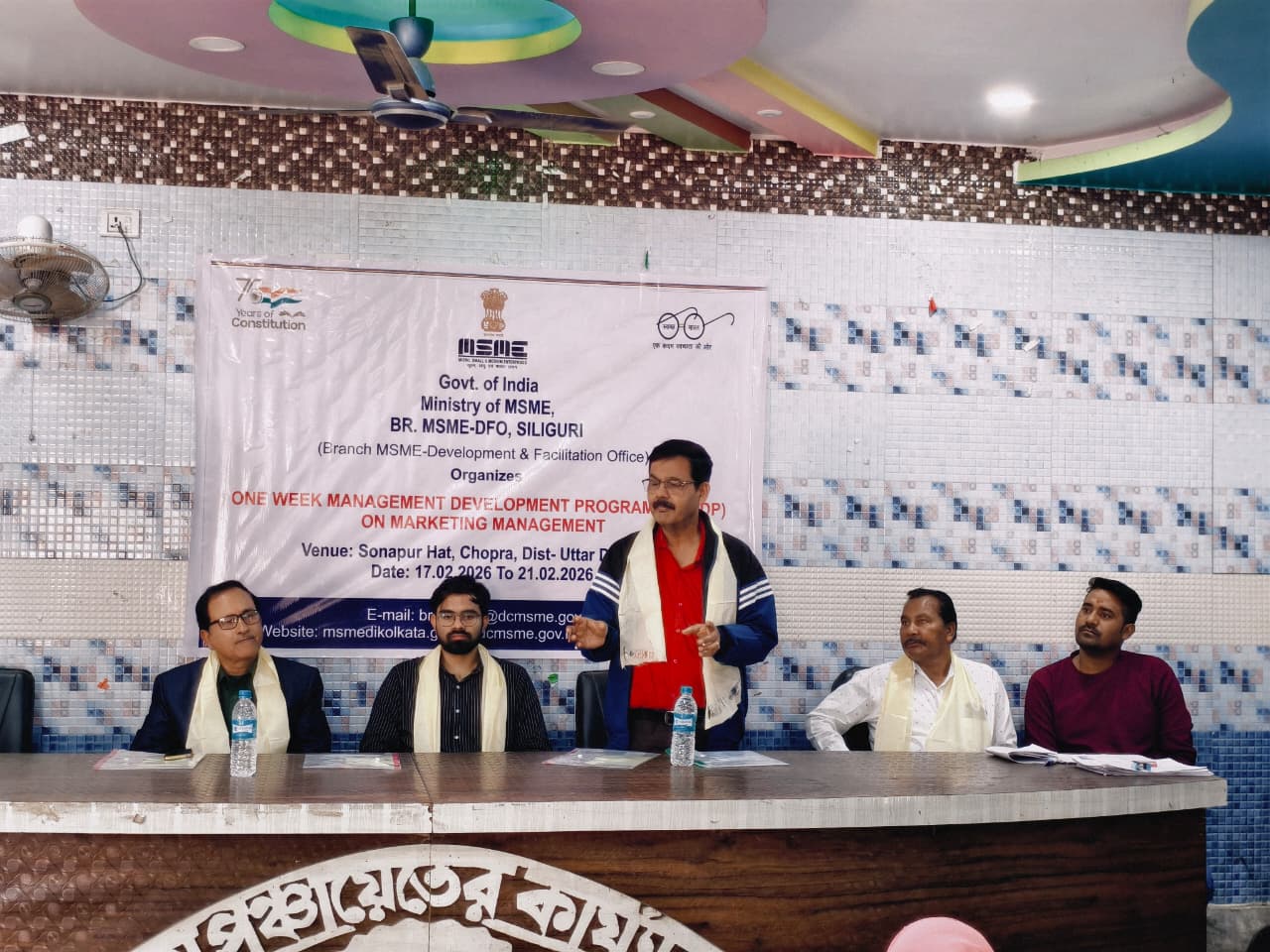
One Week Management Development Programme on Marketing Management — Sonapur Hat, Chopra, Uttar Dinajpur, West Bengal · 17–21 February 2026 · Organised by Br. MSME-DFO Siliguri
Introduction
There is a moment in every mentorship session when the room shifts — when the questions stop being polite and start being real. Someone asks something they have been holding back. Others lean forward. The conversation stops being a training and becomes something closer to a reckoning with what it actually takes to build a business.
That moment happened multiple times during the One Week Management Development Programme on Marketing Management at Sonapur Hat, Chopra, Uttar Dinajpur — organised by the Branch MSME Development & Facilitation Office, Siliguri under the Ministry of MSME, Government of India. I was there from 17 to 21 February 2026, invited as a Special Guest and Industry Practitioner. What follows is what I brought, what I found, and what I brought back.
About the MSME Management Development Programme
The MSME Development & Facilitation Office, Siliguri runs field-level programmes that take government-backed entrepreneurship training directly to smaller towns and rural constituencies — not waiting for participants to come to a city, but bringing structured knowledge to where aspiring entrepreneurs actually live and work.
The Marketing Management MDP at Sonapur Hat was designed to strengthen entrepreneurial capabilities across marketing fundamentals, customer acquisition, branding, business development, and sustainability. Participants included youth from rural communities, first-generation business families, students exploring self-employment, and small business owners seeking structured growth knowledge.
My Invitation as a Special Guest
Being invited by MSME-DFO Siliguri as an Industry Practitioner is a specific kind of recognition — not of academic credentials, but of ground-level experience. The brief was clear: bring real-world marketing and business development lessons. Not theory. Not slides full of frameworks. Lessons learned from actually running businesses, managing campaigns, building brands, and navigating the chaos that no textbook prepares you for.
That brief suits how I work. My background spans 10+ years in digital marketing, performance advertising, SEO, agentic AI, and business development — applied across e-commerce, institutional sales, artisan empowerment, and rural commerce. The session was designed around what I wish someone had told me earlier.
Sharing Real-World Marketing Lessons
The session covered ground that standard marketing curricula rarely reach: why most small businesses fail at customer acquisition not because of budget but because of trust deficit; how to build a value proposition that a customer in a rural market actually responds to; what digital marketing can and cannot do for a business that hasn’t yet defined its offer clearly; and how to use storytelling as a sales tool without it feeling manipulative.
We talked about lead generation without paid advertising, about the difference between a product and a brand, about why packaging is a marketing decision before it is a logistics one. The conversation was two-directional from the start — participants brought their own businesses and ideas into the room, and the discussion was shaped around their specific realities rather than generic case studies.
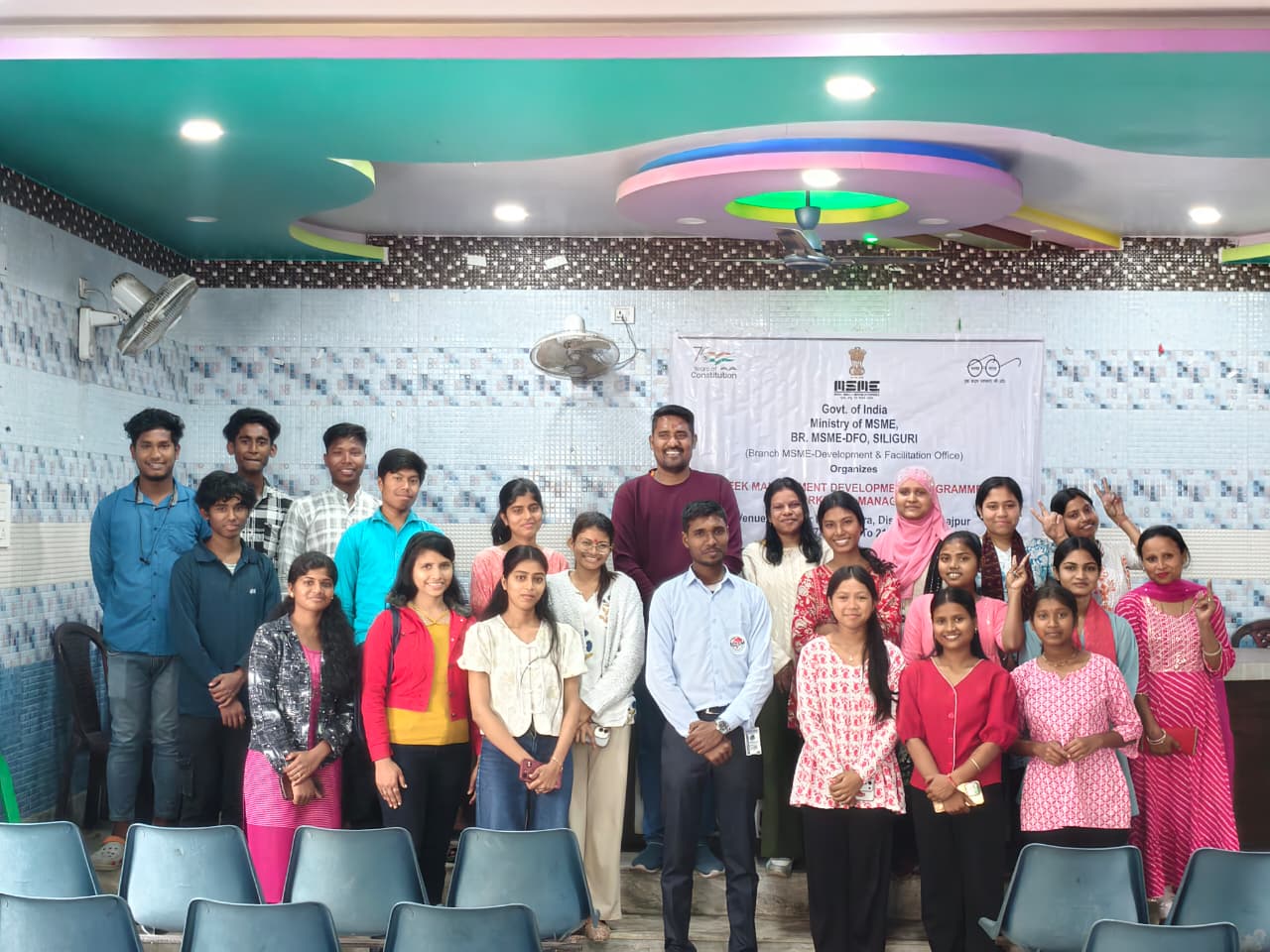
Participants at the MSME MDP Marketing Management Programme, Sonapur Hat — aspiring entrepreneurs, first-generation business owners, and rural founders from Uttar Dinajpur, West Bengal
Conversations with Emerging Entrepreneurs
Over five days, I spoke with participants who represented a cross-section of North Bengal’s emerging entrepreneurial landscape. A graduate exploring whether to launch a service business or join a family trade. A woman running a self-help group enterprise who wanted to understand digital marketing. A young man with a manufacturing idea and no clarity on how to find his first 10 customers.
What connected them was not background or business type — it was a common hunger for practical, applicable knowledge from someone who had navigated the same uncertainty. They were not looking for inspiration. They were looking for instruction. That distinction matters, and it shaped every session I ran.
Challenges Faced by New Businesses
The challenges surfaced during the MDP were familiar — because they are structural, not individual. Customer acquisition without a network is the first wall every first-generation entrepreneur hits. Without an established reputation, without family connections to buyers, without the social capital that second-generation business owners inherit, the path to the first paying customer is genuinely hard.
Brand communication was the second consistent gap. Participants had products. They could describe them functionally. But translating functional description into a compelling offer — one that makes a customer feel that buying is the right decision — is a skill that requires deliberate development. Most had never been taught it, and most had never seen it modelled in their immediate environment.
Digital marketing intimidation was real but overestimated. Many participants believed digital marketing required significant investment and technical expertise. Part of the session was simply demonstrating how much is achievable with a smartphone, a clear message, and consistent execution.
Why Marketing Matters for MSMEs
Businesses do not fail because their products are poor. They fail — in overwhelming proportion — because not enough of the right people know the product exists, understand why it is valuable, and trust the business enough to buy. Marketing is the system that solves all three of those problems simultaneously.
For MSME-scale businesses in North Bengal and across rural India, this is not an abstract point. It is the difference between a business that survives its first two years and one that does not. The MSME-DFO Siliguri’s decision to run a dedicated Marketing Management MDP reflects an understanding of this reality — and the field-level delivery model ensures it reaches founders who would never access this knowledge in a city-based programme.
Lessons I Learned from the Participants
I came to Sonapur Hat to share knowledge. I left having received as much as I gave. The participants’ questions forced me to articulate things I had been doing intuitively — which is always the most valuable kind of teaching, because it sharpens your own understanding.
More substantively: I was reminded that the entrepreneurial energy in smaller towns is not aspirational — it is operational. These are not people dreaming of starting businesses. They are already in motion, already selling, already serving customers, already navigating the daily complexity of running something with no safety net. What they need is not encouragement. It is sharper tools.
How This Aligns with Dream of Soul’s Mission
Dream of Soul was not built as a product company that occasionally does good things. It was built as an ecosystem — one where commercial operations, NGO field programmes, and export infrastructure reinforce each other toward a single purpose: building the market infrastructure that artisans, MSMEs, and rural entrepreneurs deserve.
Participating in the MSME MDP at Sonapur Hat is an expression of that mission. The free digital tools Dream of Soul Foundation builds — the Scheme Checker, the Catalogue Builder, the Market Navigator, the Artisan Onboarding tool — are direct translations of what we hear in sessions like this. Every question a participant asked in that room is a feature in one of those tools.
Guest Lecturer MSME-DFO Muzaffarpur
ISO 9001:2015
ISO 14001:2015
ZED Bronze
Section 8 NGO
12A Provisional
80G Provisional
CSR-1 Active
NGO Darpan Verified
Startup India
GeM Registered
Artisan & MSME Onboarding Tool
Register your business, build your digital identity, get market-ready. Free for every entrepreneur.
Looking Ahead
The MSME-DFO Siliguri’s field programme network reaches corners of North Bengal and Northeast India that institutional entrepreneurship development rarely touches. Dream of Soul’s engagement with that network is ongoing — not as a one-time speaker slot but as a sustained partnership in building the knowledge infrastructure that emerging entrepreneurs in this region need.
What needs to follow programmes like the Sonapur MDP is continuity — follow-up resources, digital tools, accessible mentorship, and market connections that persist after the five-day programme ends. That is precisely the gap the Dream of Soul Foundation’s free tool ecosystem is built to fill.
Final Reflections
On the last day at Sonapur Hat, a participant came up after the session ended and asked one question: “If you were starting over today, in a small town, with no connections — what would you do first?”
It is the best question anyone has ever asked me in a professional context. Because it strips away every assumption about resources, networks, and advantages — and forces an honest answer about what actually matters at the beginning. We talked for twenty minutes. I am not sure I gave a complete answer. But the conversation reminded me why field-level work like this matters more than any conference keynote.
North Bengal’s next generation of entrepreneurs is not waiting for permission. They are building, selling, failing, learning, and building again — in towns that most national business media will never cover. Dream of Soul’s mission is to make sure the market infrastructure catches up with them.