PM Vishwakarma Awareness Drive — Manihari, Katihar 2026
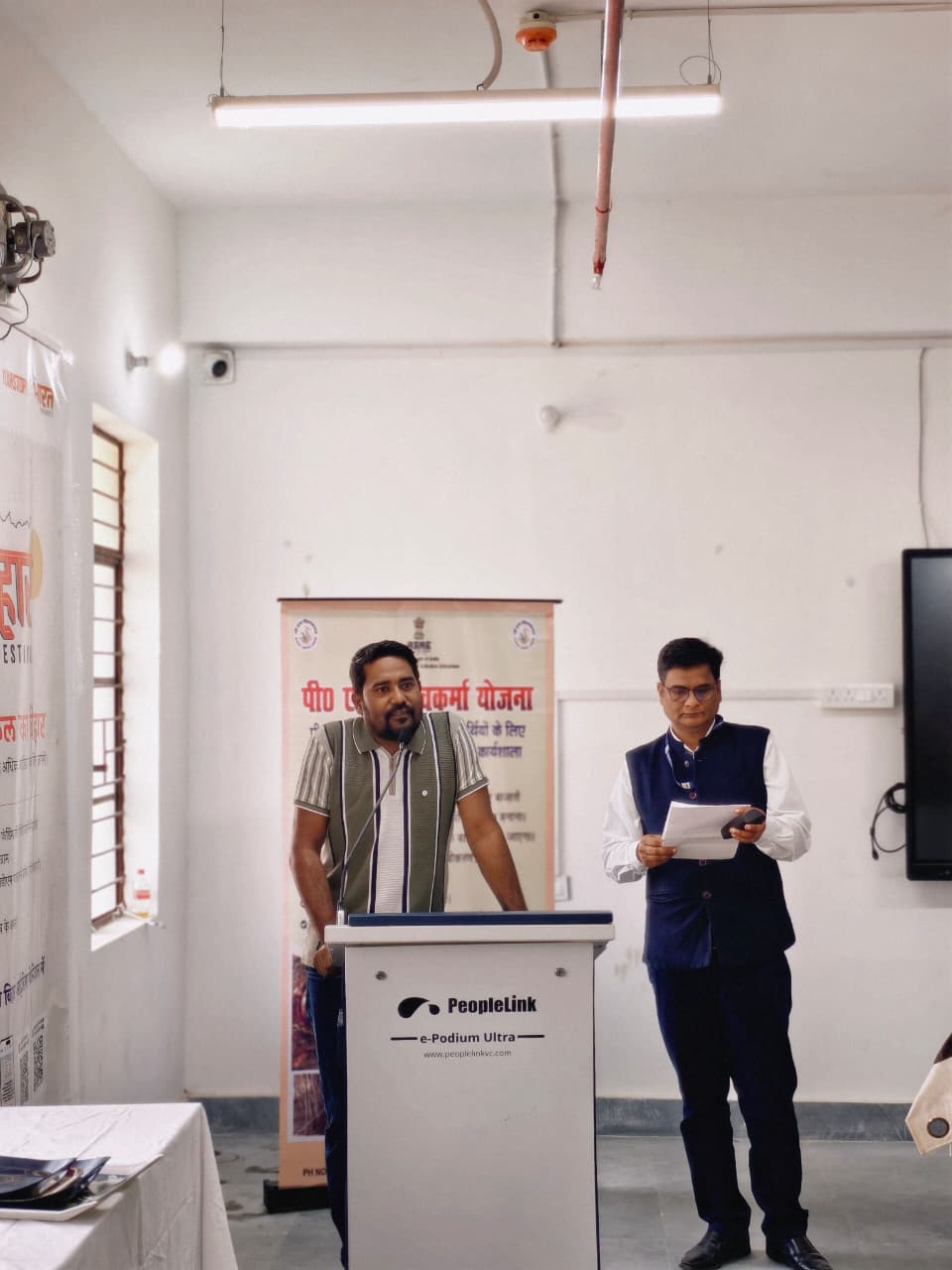
PM Vishwakarma Awareness & Entrepreneurship Drive — Manihari, Katihar District, Bihar · 7 February 2026 · Organised by MSME Development Office, Muzaffarpur
Introduction
The journey from skilled craftsman to confident entrepreneur is not a single step. It is a shift in identity — in how you see your work, how you value it, and how you present it to the world. Most artisans never make that shift not because they are unwilling, but because no one has ever framed the possibility in terms they can act on.
On 7 February 2026, I was in Manihari, Katihar District, Bihar — invited by the MSME Development Office, Muzaffarpur as a Market Trainer and Entrepreneurship Mentor under the Pradhan Mantri Vishwakarma Yojana. The day was structured around one central idea: that a skilled artisan becomes truly empowered when craftsmanship is combined with business understanding. What follows is what that idea looked like in practice.
About the PM Vishwakarma Awareness Programme
The Pradhan Mantri Vishwakarma Yojana was designed to do something structurally significant: recognise traditional craftspeople as a national economic asset and invest in their capacity not just as producers but as entrepreneurs. The scheme provides skill upgradation, modern toolkits, financial support up to ₹3 lakh, and capacity building across 18 traditional trade categories.
The Manihari awareness programme, organised by the MSME Development Office, Muzaffarpur in collaboration with local stakeholders, was the downstream expression of that investment — bringing beneficiaries together to understand how to translate scheme support into sustained business growth. I was there to make the business development dimension of that conversation as practical and actionable as possible.
My Role as Market Trainer
The invitation from MSME-DFO Muzaffarpur was for a specific kind of contribution — not a policy overview or a scheme explainer, but ground-level business and market training delivered directly to PM Vishwakarma beneficiaries. My session was built around helping participants think like entrepreneurs: understanding why customers buy, how trust influences purchasing decisions, why product presentation matters, and how to plan for growth beyond the first transaction.
The frame I used throughout was deliberately simple: your craft is your competitive advantage — your job now is to build a business around it. That reframe — from artisan to entrepreneur — is the most important mindset shift the session was designed to catalyse.
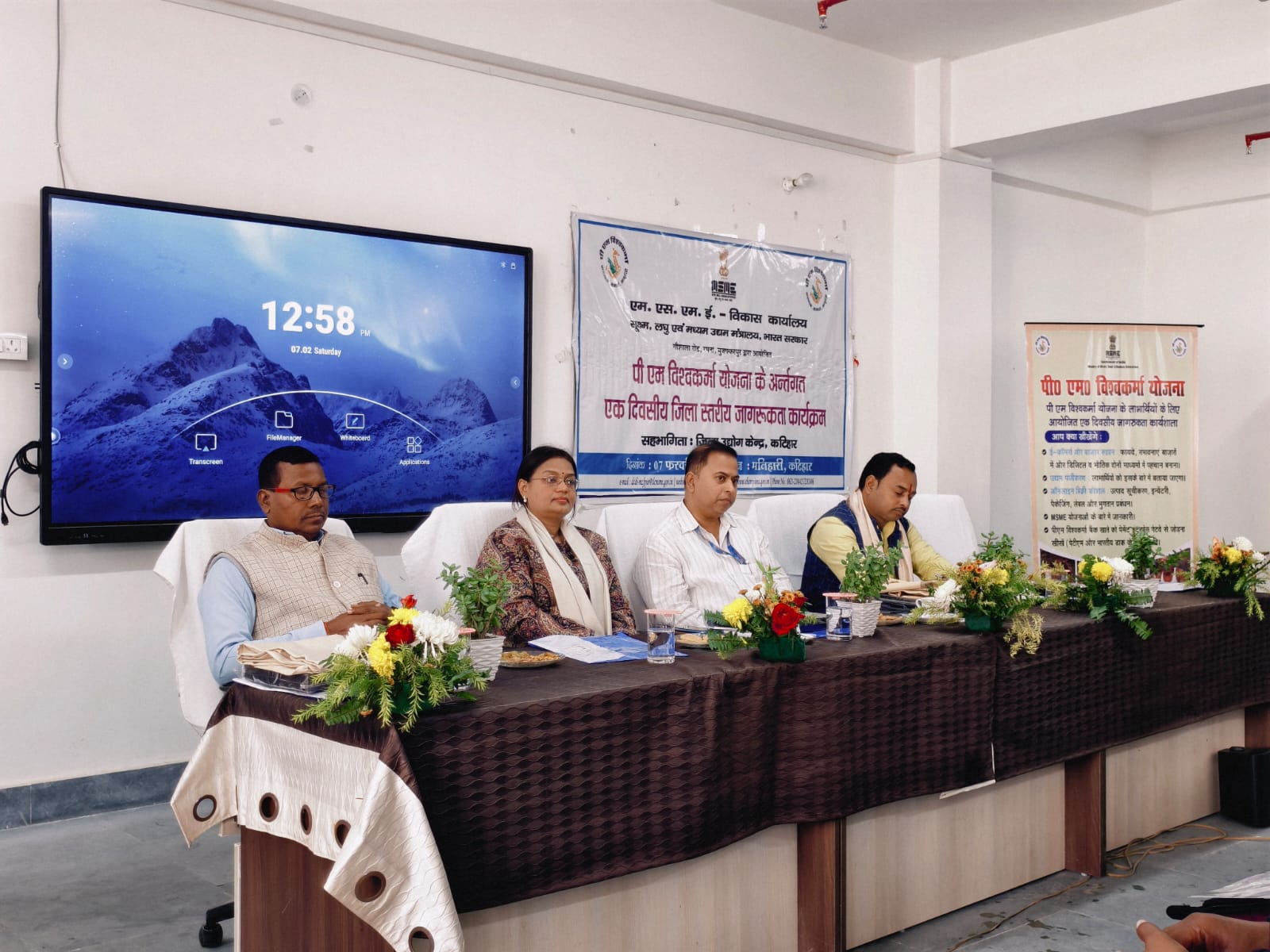
Chief guests and programme dignitaries at the PM Vishwakarma Awareness Drive, Manihari, Katihar — MSME Development Office, Muzaffarpur, Government of India
From Craftsman to Entrepreneur
The distinction between a craftsman and an entrepreneur is not about skill. It is about orientation. A craftsman asks: what can I make? An entrepreneur asks: what does the market need, and how do I reach the person who will pay for it? The best outcomes happen when both questions are asked by the same person — and the session in Manihari was designed to begin that integration.
We worked through customer expectations — how they are changing, what urban and premium buyers look for, and why the gap between what artisans produce and what buyers want is often smaller than it appears. We covered business planning basics: not financial modelling, but the simple discipline of knowing your costs, setting prices with margin, and planning production around demand rather than habit.
Conversations with Beneficiaries
The conversations between sessions were where the real texture of the day emerged. An artisan from a family of weavers, three generations deep, describing how a single large buyer had controlled his prices for years because he had no alternative channel. A craftsperson who had received the PM Vishwakarma toolkit but had no clarity on how to use the credit support effectively. A younger participant — the first in his family to consider selling online — asking which platform to start with and why.
Each of these conversations is a specific, solvable problem. And each of them points to the same structural gap: scheme benefits reach artisans; market knowledge often does not. Closing that gap is the purpose of programmes like this, and of the organisations that participate in them.
Why Business Mindset Matters
Craft skills are inherited, refined, and often extraordinary. Business skills are learned — and they can be learned at any stage. The participants at Manihari demonstrated this clearly: the willingness to engage with concepts like customer segmentation, trust-building, and long-term growth strategy was high. What had been missing was not capacity for learning but access to the right learning in the right context.
A sustainable livelihood for an artisan is not built on one good sale or one government scheme. It is built on a repeating cycle of quality production, customer trust, fair pricing, and consistent market access. Business mindset is what holds that cycle together — and it is exactly what awareness programmes under PM Vishwakarma, at their best, exist to cultivate.
Lessons from the Ground
The day in Manihari confirmed something I observe consistently across field programmes in Bihar: the resilience of rural entrepreneurs is not a cliché — it is a documented reality. These are people who have been building businesses without infrastructure, without networks, and without market knowledge, and have been doing it anyway. What they need is not motivation. It is the specific, applicable knowledge that makes their existing effort more effective.
The second lesson is about the role of mentor-practitioners in government programmes. The most effective sessions are not the ones where an expert delivers a curriculum. They are the ones where an industry practitioner sits with beneficiaries, works through their specific situations, and leaves them with three things they can do differently starting the next morning.
Building Sustainable Livelihoods Through Knowledge
India has millions of skilled artisans. The question of whether those skills become sustainable livelihoods depends almost entirely on access to knowledge, mentorship, and market connections — not on further skill development, which is already strong. The PM Vishwakarma Yojana has correctly identified this and is investing in awareness and capacity building as core programme components.
What needs to accompany that investment is continuity — follow-up resources, digital tools, accessible mentorship, and market infrastructure that persists after the awareness programme ends. That is the work Dream of Soul Foundation exists to do.
How This Aligns with Dream of Soul’s Mission
Dream of Soul was not built as a product company with a social impact side project. It was built as an ecosystem — one where the Foundation’s field programmes, the proprietorship’s commercial operations, and the LLC’s export infrastructure all serve the same purpose: building the market access infrastructure that India’s artisan economy has always deserved but rarely received.
Being invited to mentor PM Vishwakarma beneficiaries in Manihari is not peripheral to that mission. It is central to it. The free digital tools we build, the institutional procurement channels we develop, the export pathways we establish — all of it begins in conversations like the ones that happened at Katihar on 7 February 2026.
Market Trainer GoI
ISO 9001:2015
ISO 14001:2015
ZED Bronze
IEC Export Enabled
Section 8 NGO
12A Provisional
80G Provisional
CSR-1 Active
NGO Darpan Verified
GeM Registered
PM Vishwakarma Scheme Checker
Check eligibility for PM Vishwakarma and 10+ government schemes instantly. Free for every artisan.
Looking Ahead
The MSME Development Office, Muzaffarpur’s field programme network across Bihar is one of the most active government-led entrepreneurship development systems operating at the grassroots level in Eastern India. Dream of Soul’s ongoing engagement with that network — as Market Trainer, Market Expert, and field programme participant — reflects a long-term commitment to the artisan economy of Bihar and West Bengal.
What programmes like Manihari make clear is that the demand for market knowledge and entrepreneurship mentorship among PM Vishwakarma beneficiaries is not a niche need. It is universal across every district, every craft category, and every stage of business development. Meeting that demand at scale requires both government infrastructure and independent organisations willing to show up, repeatedly, on the ground.
Final Reflections
At the end of the day in Manihari, I sat for a while with a craftsman who had been practicing his trade since he was a teenager. He was in his forties now. He had watched his craft lose market share to cheaper, machine-made alternatives. He had stayed with it anyway — because it was his, because it was his family’s, because he believed it was worth something.
He was right. It is worth something. The question is whether the market infrastructure around him catches up quickly enough to show him that. That urgency — to build the infrastructure before the craftsmanship is lost — is what drives everything Dream of Soul does in the field.