PM Vishwakarma Awareness Camp — Srinagar, Purnea 2026
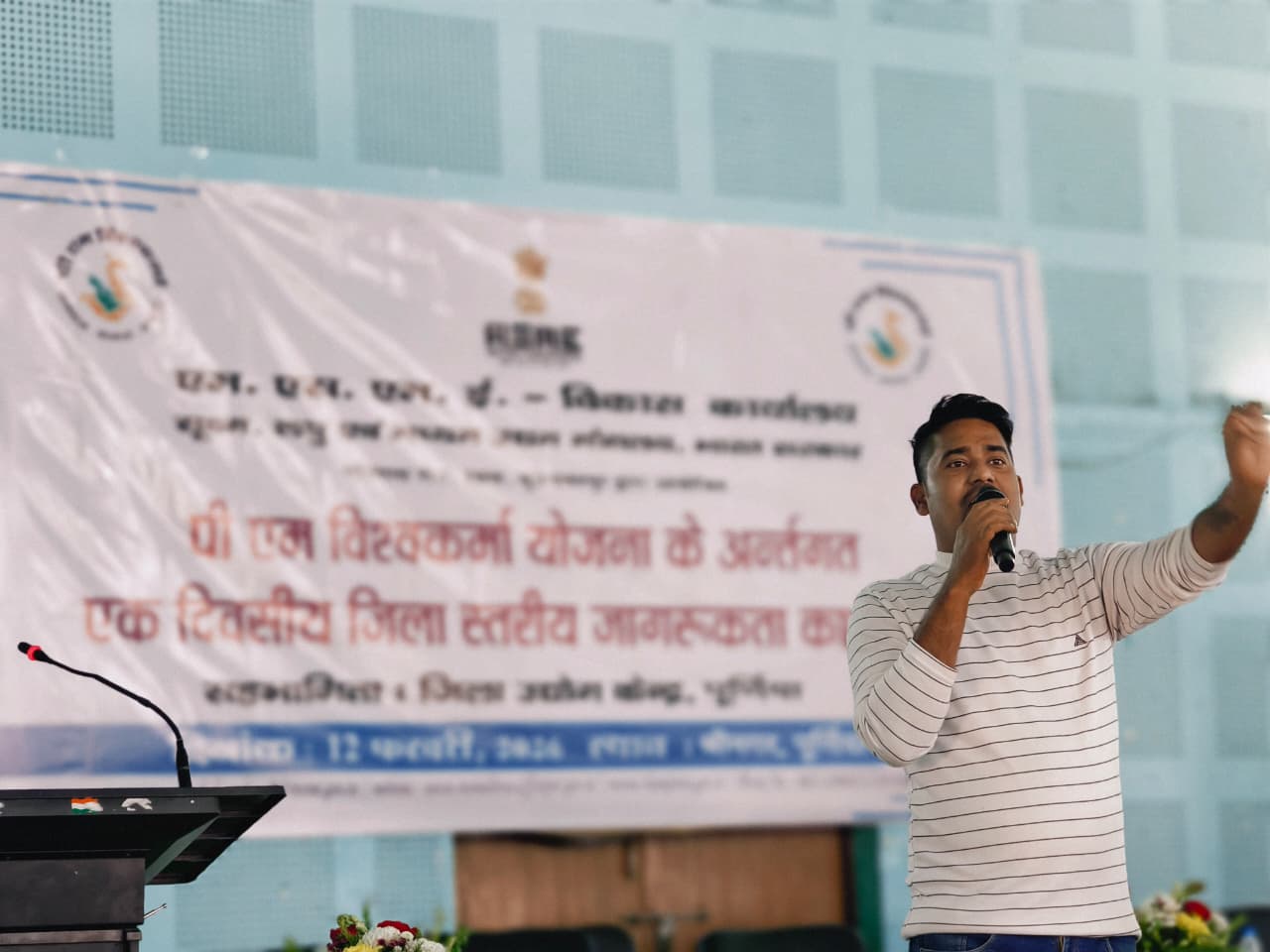
PM Vishwakarma Awareness & Entrepreneurship Programme — Srinagar, Purnea, Bihar · 12 February 2026 · Organised by MSME Development Office, Muzaffarpur
Introduction
There is a specific weight to standing in front of a room full of artisans who have spent their lives mastering a craft — and being asked to explain why their work is not selling the way it should. It is not a comfortable position. But it is an honest one. And honesty is where useful conversations about market linkage begin.
On 12 February 2026, I was in Srinagar, Purnea, Bihar — invited by the MSME Development Office, Muzaffarpur as a Marketing Mentor under the Pradhan Mantri Vishwakarma Yojana. The session was designed for PM Vishwakarma beneficiaries: traditional craftspeople who had received skill and toolkit support from the scheme and now needed the piece that comes after — a market to sell into and the knowledge to reach it.
About the PM Vishwakarma Awareness Programme
The Pradhan Mantri Vishwakarma Yojana provides traditional artisans with skill development, modern toolkits, credit support up to ₹3 lakh, and capacity building. The Purnea awareness camp was the downstream continuation of that work — moving from tool and skill provision toward the harder question of market connection.
Organised by the MSME Development Office, Muzaffarpur at Srinagar, Purnea, the programme brought together PM Vishwakarma beneficiaries from across the district — craftspeople working in traditional manufacturing, handicrafts, and rural product sectors, all with a common need: understanding how to take what they make and find the buyers who will pay what it is worth.
My Invitation as Marketing Mentor
The MSME Development Office, Muzaffarpur invited me in a specific capacity — not as a speaker delivering a motivational address, but as an Industry Practitioner bringing applied marketing knowledge directly to PM Vishwakarma beneficiaries. The brief was practical: help artisans understand how their products can reach customers beyond their immediate geography, and what they need to do differently to make that happen.
That brief is one I have been preparing for — without knowing it — for over a decade of working in digital marketing, performance advertising, e-commerce, and MSME business development. The session was built entirely around what actually works for small producers trying to reach larger markets, with no theory that does not translate directly to action.
Helping Artisans Understand Modern Markets
The session opened with a question I ask in every context where I work with artisans: Who is your customer? Not a demographic description. Not “anyone who wants handmade products.” A specific person, with a specific need, shopping in a specific place, willing to pay a specific price. Most participants had never been asked to think about it this way — and the discussion that followed was the most generative hour of the day.
From there, the conversation moved through branding and product presentation — why two identical products, one packaged well with a clear story and one not, will sell at prices that bear no relationship to each other. Through digital commerce — what platforms exist, what each requires, and which makes the most sense for a craftsperson starting from zero. Through customer trust — the single most undervalued asset in rural enterprise, and the one that takes longest to build and shortest to lose.
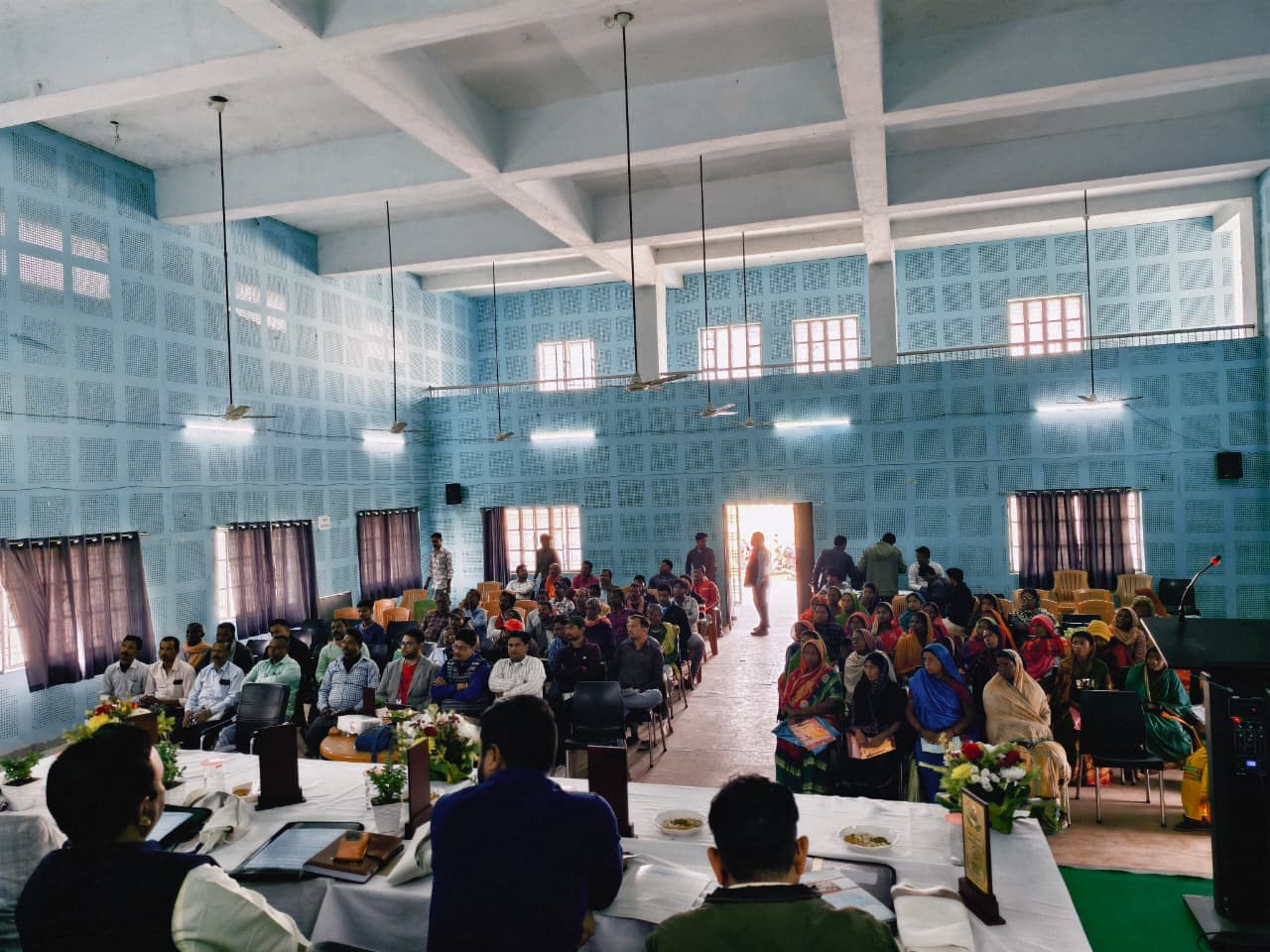
PM Vishwakarma beneficiaries at the Srinagar, Purnea awareness camp — traditional craftspeople engaging with market linkage, branding, and digital commerce sessions
Conversations with PM Vishwakarma Beneficiaries
The most valuable part of any field programme is not the session itself — it is the conversations that happen around the edges. A craftsman pulling out his phone to show a product he had been trying to list online for months, asking why no one was buying. A woman artisan describing how a middleman had been taking 60% of her sale price for years because she had no direct access to buyers. A young participant who had inherited his family’s craft but wanted to sell on Amazon and did not know where to start.
Each of these conversations is a specific, solvable problem. And each of them confirmed something I have observed consistently across Bihar and West Bengal: the artisan community is not passive about its situation. It is actively looking for the infrastructure that allows it to act differently. The role of a programme like this is to provide that infrastructure — in knowledge form — directly, without gatekeeping.
Challenges Faced by Traditional Craftsmen
Intermediary dependence was the most consistently cited challenge — a structural condition where artisans have no direct buyer relationships and therefore no pricing power. Digital literacy gaps came next: not an unwillingness to use digital tools, but a lack of practical guidance on which platforms to use and how to set them up correctly for commerce.
Packaging and presentation remained the most visible gap. Products that would photograph beautifully with minimal investment were being sold unpackaged, unlabelled, and without any brand identity. The cost of the gap is not just aesthetic — it is the difference between ₹100 and ₹500 for the same item, multiplied across every unit sold over a lifetime of craft production.
The Power of Digital Commerce for Artisans
Digital platforms have created something genuinely new for India’s artisan economy: the possibility of geographic independence. A craftsperson in Purnea, Bihar no longer needs a distributor in Mumbai to reach a buyer in Bangalore. They need a smartphone, a product that photographs well, a clear description, and a platform account in good standing.
That is achievable. It is not simple — it requires consistent quality, reliable fulfilment, and the patience to build reviews and trust over time. But it is achievable, and the PM Vishwakarma Yojana’s investment in skill and toolkit support creates the upstream conditions that make downstream digital commerce possible. The link between those two ends of the chain is market knowledge — which is exactly what sessions like this exist to provide.
How This Connects with Dream of Soul’s Mission
Dream of Soul was founded on a specific conviction: that artisans deserve access to markets on terms that are fair, transparent, and sustainable — not as a welfare outcome but as a commercial correction. The PM Vishwakarma programme at Purnea is an expression of the same conviction from the government side, and the alignment between the two is not incidental.
The free digital tools Dream of Soul Foundation has built — the Scheme Checker, Market Navigator, Catalogue Builder, and Artisan Onboarding Tool — are direct responses to what we hear in rooms like the one in Srinagar, Purnea. Every question asked that day has a corresponding feature in one of those tools.
Marketing Mentor GoI
ISO 9001:2015
ISO 14001:2015
ZED Bronze
IEC Export Enabled
Section 8 NGO
12A Provisional
80G Provisional
CSR-1 Active
NGO Darpan Verified
GeM Registered
PM Vishwakarma Scheme Checker
Check eligibility for PM Vishwakarma and 10+ government schemes instantly. Free for every artisan.
Looking Ahead
The PM Vishwakarma programme at Purnea was one day. The work it points toward is permanent. Market linkage for India’s artisan economy is not a programme — it is infrastructure that needs to be built, maintained, and expanded continuously as the artisan community grows its capacity and ambition.
Dream of Soul’s engagement with the MSME Development Office, Muzaffarpur continues across Bihar. The field intelligence we gather in sessions like this directly informs the tools we build, the procurement channels we develop, and the export pathways we are establishing through Dream of Soul LLC for artisan products to reach international buyers.
Closing Reflections
At the end of the session in Purnea, an artisan came up and asked me to look at a photograph of his work on his phone. It was extraordinary — the kind of craftsmanship that stops you. He wanted to know if it could sell online. I told him not only could it sell, it could sell at a price he had probably never received for anything he had made.
His expression was not excitement. It was something quieter — the careful recalibration of someone who has been undervaluing their own work for a long time and is only now beginning to understand the real number. That recalibration — of value, of possibility, of market — is what programmes like this and organisations like Dream of Soul exist to catalyse.